Showing posts with label voice-over. Show all posts

Tuesday, July 31, 2012

A power failure and you are recording !!!


It just happened in India, it could happen to you too !


Grids supplying electricity to half of India's 1.2 billion people collapsed, trapping coal miners, stranding train travelers and plunging hospitals into darkness in the second major blackout in as many days.

A blackout could happen anywhere, anytime and it could be devasting for your business as a voiceover talent. Imagine you are in your booth recording this long script that absorbs all your concentration and the power fails? Your time and effort is wasted and it could also damage your reputation as you might not be able to meet your deadline to your client. A power failure could be temporary nuisance or as in India last for too many hours, but sooner or later the power would arrive at the mains and then cross your fingers !  The power could come with undesired peaks that could ruin your recording equipment.

But there is a solution for this problem as any sound studio knows.
Here is our CHECKLIST of things to do to protect your home studio in case of power failure
  1. Buy a Uninterrupted Power Supply or UPS at any computer store. You can buy it at around $ 70 or € 50. It's basically a battery that stores DC electricity and transforms into into AC at the normal current you use 110 or 220 V.  
  2. The UPS should be connected to the computer on which you are recording the audio, so when power fails you have still 5 to 10 minutes (depending on UPS battery capacity) to save your precious recordings and shut down.
  3. Make sure that the battery is standard and you can buy the replacement anywhere (even a do it your self stores). The UPS battery has a capacity of up to 1000 charges and could last for 3 years.
  4. Or consider buying a more powerful UPS in the first place if you want to go on recording no matter the power failure. It could cost you from $ 500 or 600 €. You will need it for your preamp that also use electricity and feeds your mic with phantom power. We stress that the UPS should be of much better quality, because a standard, cheap UPS will introduce unwanted noise into your recording, since the alternative power is not streamlined.
  5. A stronger UPS unit should be connected to computer, preamp and screens and can provide filtered good quality electricity for 15 minutes with some luck.  You can then finish the part of the script you were reading and then save everything.
Another reason to have a UPS interconnected is that you will protect your equipment from power surges when electricity goes on and off after a storm for example. Also your valuable telephone lines or ISDN. This unit below has 8 outlets.


Friday, December 16, 2011

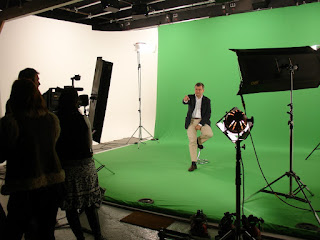
On Camera Live Coverage. How ?


I'm a journalist not an actor, so how can I face a camera and have a fluent meaningful speech that sounds and looks natural ?

Well you haven't been trained to do it, but it doesn't matter, this is a matter of practice, a lot of practice. Here are some tips for you:

1) Prepare your subject matter. really brood over the topic you are going to talk about until it becomes part of your knowledge, until you can explain it from different angles and with different words and expressions. If you have to talk to a wide audience through a camera lens you need to do as any soldier will do to combat, get the right ammunition and weapons. That means for you arguments and clear views on what you are talking about.

2) Do not memorize the topic. Preparing a subject does not mean to learn by heart a text and then say it like a talking machine. Dale Carnegie writes that "the man who writes out and memorizes his talks is wasting his time and energy and courting disaster". You should think of ideas, not words. As Carnegie points out "if your ideas are clear, the words come as naturally and unconsciously as the air we breathe.

3) Read with your mind open. Contrary to conventional wisdom, actors don't learn line by line, literally recording in their minds the sentences. The process is reading over and over again the key texts of your speech and bullet points. This assimilation process should take place casually and during the best moments of they when there is no pressure.

4) Rehearse. Yes, you need to practice in front of someone who can direct you, or if you are alone in a hotel, do it in front of a mirror. Don't worry if the speech changes everytime, remember you are not a machine, you will express ideas not a collection of words, that means that you can formulate your ideas in different fashions, as long as they are clear and you are standing in full control.

5) Keep control. It is natural that you feel uneasy and in tension when you know that you are going to do a live presentation on camera. That is good, because it means your adrenaline is flowing in your mind and body, so when the moment comes you will be able to be sharp. Get your mind off you and focus on the subject matter.

6) Keep it cool on-camera. When you are reporting life in front of camera, you will be standing for a while, maybe several minutes before the anchor greets you and asks you questions. You will not be able to see him, but you have to look at the camera without moving too much. While you wait just relax and maybe think about the key messages of what you are going to say. Then add energy and personality to your sentences, but don't get nervous if a word is misplaced, if you suddenly forgot something.

At PrimeVoices' studios we record voice-overs in multiple languages. We have a casting of native voice talents from all over the world. From simple voice-over to more elaborate dubbing or lip-sync, at PrimeVoices we can also mix the speech track with music or just background sound. With three studio suites, we can perform any post-production from video editing, to subtitling and captioning.
With PrimeReporters, a branch of PrimeVoices, we organise coverage of world events like elections or summits, supplying ready-to-air reports to international broadcasters.


Friday, December 9, 2011

Robotic Voices

You hear them more and more. Their metallic sound, cold and neutral and of course outlandish. Robotic voices are conquering our public spaces, a vocal matrix of instructions and messages, avant-garde of the new controlled society. I hear them every time I drive out of the parking lot at the Lyon airport: "Merci pour votre visite, bonjour". The message is clear, but the inhuman sound is also perceived by my mind as an android sound. I wish it were so pleasant, even funny and sophisticated as C3PO the protocol droid from Star Wars. No way near.

But hey, let's not reject this technology. As you can probably hear in your own computer, some synthesized voices are very close to the real thing. Google has made an impressive progress with its plugin that can emulate human speech. Just try this, write define, then write any word. You can then look up both the meaning of the word and listen to the right pronunciation.

Will this technology ever replace the job of voice talents, well not entirely. The human voice carries more than just information, it transports emotions that a machine can't reproduce. But voice artists and studios beware, one day not so far in the future, the technology might surprise you. Some companies are developing that software that can read any script in most languages with the rhythm, intonation and pitch you want. But then to avoid a ridiculous expression, there always be a human being behind the puppet.


Friday, February 5, 2010

Impostare, or how to use the voice at its best

The Italians and Spaniards have a word for it: impostare, impostar...
This means the act of concentrating the strength of the voice on the vocal cords, so that the sound that comes from it is full and round, but mostly non hesitant and firm.

In other words it is a non natural exercise that needs training, that is why it's a job, because you need concentration, vocal skills and experience. If you have the chance to see how radio voices or professionnal announcers behave in front of the mike, you will see what I mean. Their voice suddenly changes to a sound that is completely different from the natural tone of voice of the person. It is a real transformation that you can not only hear, but also see. All of a sudden the voice talent changes is face and posture, he starts articulating also in a kind of artificial fashion, so opening the mouth, as if to pronounce better the syllables. And, yes, the actor can move hands and body, provided that he does it silently, to give that special concentration and emotion to the voice. At PrimeVoices we are very aware of that process, so we have witnessed at our studios many kinds of body languages, most funny of all was an Arabic voice that before the recording session started just lied down on the floor to breath and relax, then he started to made funny sounds as if to release the voice. The ritual ended with a massage of the cheeks to made them more flexible. The voice had a rather high pitch voice for a talent, but in front of the mike his voice turned out to be deep and solemn, we were really impressed...

Tuesday, January 12, 2010

Are voices responsible for a bad script ?

No, unless they are authors. But in real life this is not that simple. When the voices get a poor translation full of mistakes and not understandable expressions, it is a professional obligation to let the client know about the issue. If that is possible, it is good to suggest an improvement of the text if this is really possible, but on many instances, clients can't decide or they just say to you: sorry this text was validated by the company so we have to stick to it. If no solution is on sight, you don't have other choice but to insist. In the case that the text can be corrected on the spot, then what we do at PrimeVoices is recording two versions, one as it should, and the other as it is. We submit both recordings to the client and warn him that further changes should be paid. In other cases, the text is fine but not convenient to do a voice-over, as it is too long or too short, or just written in a convoluted way. If matching the pictures is a must, as it happens with all videos, then we have to apply some editing skills. When we get texts in English and then we do other language versions, we insist that translations should respect the timings, but it is rare that the translator work with a screen in front and TC.

Monday, December 28, 2009

Half an hour rec. session for just four words ?


Oh, certainly that's the minimum if you want to record the real thing !
And that's precisely what we are showing in this video clip: the recording session actually lasted for a whole day, because we recorded nine language versions in a row of a one single 5'' billboard. Time and dedication were invested not just because it's about a very famous and prestigious brand, but also due to the fact that this advert is showing on a well-known international TV station.
So it's a kind of rule: the smaller the text, the longer the time devoted to recording.
How can that contemplation can be justified? Well, everything starts with the translation, not easy either, because here you rather adapt a text for a target audience, instead of a simple conventional translation that could ruin both the original meaning and spirit of the slogan or advert. Once the text is validated by the client, we then have to choose the right voices. In this case, the keyword was elegance, because both the brand and the program that is sponsored have that in common: culture, refinement, status and prestige. So Grazia our artistic director chose not just another deep voice, but a distinguished voice like that of our friend Jean-Claude. Like his other colleagues (Spanish, English, German, Italian, Portuguese, Russian, Arabic and Turkish) Jean-Claude had to convey in those four words the right elegant pitch, the vocal vibrations that prompt in your mind those brand values the client wants to convey. Sergio, our engineer, equalized the voice track with some good old tube sound to highlight warmth and proximity. Then normalized and exported the track in the right broadcasting format.
So as you can see in our main characters of the video, Jean-Claude, Sergio and Grazia, recording a billboard is not a factory process, it's a delicate operation that needs patience, care and also sense of humor.
Check out: http://www.primevoices.com


FRENCH
Une séance d'une demi-heure pour a peine 4 mots ?
Oui, certainement c'est le minimum si vous voulez un résultat vraiment pro!
Et c'est précisément ce que nous montrons dans le clip vidéo ci-dessus: la séance d'enregistrement et post-prod avait duré toute une journée, parce que nous avons effectué neuf versions linguistiques d'un slogan publicitaire de 5 mots. Du temps et du travail ont été investis non seulement parce que il s'agissait d'une marque très célèbre et prestigieuse, mais aussi en raison du fait que cette annonce serait diffusée sur une chaine de télé international très connu.
Donc c'est une sorte de règle: plus petit est le texte, plus long le temps consacré à l'enregistrement.
Comment cette contemplation peut être justifiée? Eh bien, tout commence par la traduction, pas facile non plus, car ici vous adaptez plutôt un texte destiné à un public cible, au lieu d'une traduction classique  et simple qui pourrait ruiner à la fois la signification originelle et l'esprit du slogan. Une fois le texte validé par le client, nous devons alors choisir les voix les plus appropriées. Dans ce cas, le mot clef est l'élégance, parce que tant la marque que le programme qui sponsorise ont cela en commun: la culture, le raffinement, le statut et le prestige. Ainsi Grazia, notre directrice artistique, avait cherché et trouvé une voix distinguée comme celle de notre ami Jean-Claude. Comme ses autres collègues (espagnol, anglais, allemand, italien, portugais, russe, arabe et turque) Jean-Claude devait faire passer dans ces quatre mots, ce pitch élégante et ces vibrations vocales qui transmettent les valeurs de marque si chers au clients. Sergio, notre ingénieur, avait égalisé la piste vocale avec le bon vieux tube a fin de mettre en évidence la chaleur et la proximité. 
Donc, comme vous pouvez le voir dans nos personnages de la vidéo, Jean-Claude, Sergio et Grazia, l'enregistrement d'un billboard publicitaire n'est pas un processus d'usine, c'est une opération délicate qui nécessite de la patience, de l'inspiration et aussi le sens de l'humour

Jetez un coup d'oeil sur : http://www.primevoices.fr

Friday, December 25, 2009

Voice-Over in Christmas time? Don't do it


Drinking too much, eating too much ? Well it's Christmas time so you have licence to get those extras that your body doesn't need, besides you are not working so no need to be sober. Having said that you know that the voice can sound differently if you are hungry or if you have eaten too much. Yes the voice can also be a gauge of appetite or perhaps an energy indicator.
So let's say that the energy indicator is on the red side, because energy is low and appetite big, this kind of situations could happen for instance when we have to read a script late in the evening after a long tiring day, it is really tough to make it sound fresh and interesting. You could certainly cheat and make it sound authentic and committed, but, man, what an effort !. If you have to read a long script, the voice is really put to the test. In case we are dealing with a voice-over matching a video, or even more difficult a lip-synch dubbing, then the level of concentration is so high, that it would even be irresponsible to record in the studio at that moment, as the result might not be what it should be.
Now let's suppose the opposite: the gauge is green because we have eaten a good breakfast and we are also full of energy because we have slept and therefore rested. Concentration is high, well after a good coffee, and therefore we can read properly and making good sense with the lines.
So let's be aware, that to use the voice to put life, feelings and more to any text, you need to choose the right moment of the day, but if you eat or drink too much, well then just use your voice to make a joke to your friends, sing in a karaoke, or, if needed, snor and rest.
Merry Christmas, Feliz Navidad, Joyeux Noel !!!
Check out: http://www.primevoices.com

FRENCH
Voix Off à Noël? Pas la peine
Trop manger ou trop boire ? Eh bien, c'est le temps de Noël, donc vous avez bien la permission pour obtenir ces extras que votre corps n'a pas besoin, en plus vous ne travaillez pas, donc pas besoin d'être sobre. Vous savez bien que la voix peut sonner de façon différente en fonction de si vous avez faim ou si vous avez trop mangé. Oui, la voix peut être également une jauge d'appétit, autrement dit un indicateur de l'énergie.
Alors disons que l'indicateur d'énergie est sur le côté rouge, parce que l'énergie est faible et don l'appétit et conséquent; ce genre de situations peuvent se produire par exemple lorsque nous avons à lire un script tard dans la soirée après une journée fatigante, en ce-moment-là est vraiment difficile d'avoir un son frais et intéressant. Vous pourriez certainement tricher et rendre un son authentique et engagé, mais, quel effort !. Si vous devez lire un long script, la voix sera vraiment mis à l'épreuve. Au cas où nous avons affaire à une voix off pour vidéo, ou encore plus difficile une synchronisation labiale, donc le doublage ADR, alors le niveau de concentration sera si élevé qu'il serait même irresponsable d'enregistrer dans le studio à ce moment, parce que le résultat ne pourrait pas être ce qu'elle devrait être. 

Maintenant supposons le contraire: la jauge est verte parce que nous avons mangé un bon petit déjeuner et nous sommes également pleins d'énergie parce que nous avons bien dormi et donc nous sommes reposés. La concentration est forcement élevée, après un bon café, et nous pouvons donc lire correctement et faire le bon sens avec les phrases du script.
Alors, soyons conscients que, pour utiliser la voix pour faire vivre un texte, pour le donner de la passion, de l' authenticité, vous devez choisir le bon moment de la journée, mais si vous mangez ou buvez trop, eh bien il suffit d'utiliser votre voix pour raconter une blague à vos amis, chanter dans un karaoké, ou, si nécessaire, bien aller se coucher.
Merry Christmas, Feliz Navidad, Joyeux Noel !

Jetez un coup d'oeil: http://www.primevoices.fr

Thursday, December 24, 2009

Voice it, but first understand what you are saying !


If you do voice-over for a living, because you are a radio or TV journalist, or a professional announcer, I'm sure you are confronted with a simple fact: you can't read properly if you don't understand what it's written. Well, you could argue, a real voice artist can read any text in any way you ask him to, and not just that: a real voice artist can do some magic too: a stupid or even fluffy text can sound interesting and even intelligent if you apply the right dose of salt and pepper tweaking your voice and applying the right pitch, rhythm and intonation. If you add to that the technical savvy of a good sound engineer and the latest digital sound recording technology the result can be impressive. So beware of nice sounding voices, they can just make you believe or buy almost anything. That explains why some artists get paid nicely because their persuasive voices get the message across to your mind and that is the goal of publicists, preachers and, yes, journalists. Some journalists believe that just reading the facts and showing the pictures is enough to communicate, well they are wrong. They have to put something more of themselves than just the vocal cords, or their news item will be just another boring piece of information.
Check out http://www.primevoices.com


FRENCH
Lisez au micro, mais aprés avoir bien compris le texte !
Si vous travaillez dans la voix off pour vous gagner votre vie, soit parce que vous êtes un journaliste de radio ou de télévision, ou bien un speaker / comédien professionnel, je suis sûr que vous êtes toujours confronté à un simple fait : vous ne pouvez pas lire correctement si vous ne comprenez pas ce que c'est écrit. Eh bien, on pourrait penser, un vrais comédien peut lire n'importe quel texte de quelque manière que vous le lui demandez, et pas seulement: une artiste vraie peut faire un tour de magie avec sa voix: un texte stupide, voire vide peut même paraître intéressant et intelligent, à condition d'appliquer la bonne dose de sel et de poivre dans la voix et ajuster rythme et l'intonation. 
Si vous ajoutez à cela le savoir faire technique d'un bon ingénieur du son et les dernières technologies numériques de l'enregistrement sonore, le résultat peut être impressionnant. Alors méfiez-vous des voix qui sonnent, ils peuvent tout simplement vous faire croire ou acheter presque n'importe quoi. Cela explique pourquoi certains comédiens sont très bien payés parce que leur voix persuasive fait passer le message à votre esprit et tel est l'objectif des publicistes, des prêtres et, oui, des journalistes. 
Certains journalistes estiment que la simple lecture des faits avec les images est suffisant pour bien communiquer, eh bien ils ont tort. Ils doivent mettre quelque chose de plus propre que seulement les cordes vocales, ou leurs infos seront juste une autre pièce ennuyeuse qui déclenchera l'indifférence et le zapping.
Jetez un coup d'oeil sur http://www.primevoices.fr

Wednesday, December 23, 2009

Some debut, breath and survive


The reason I'm starting to write this blog is to speak out about the tricky business of doing a voice-over be it in English or Spanish or any language for that matter.


It is a business, but also an art, where you always strive for perfection. So how about some background to answer the question: why on earth did I end up reading on a mike and then turning this skill into a business? Well I never looked for it really, it just happened to me by a set of circumstances. To start with it was not in Spain, my beloved country, but in Holland, where I ended up as a student eager to work for an international radio station like Radio Netherlads, or the Wereldomroep (photo above), as it is called in Dutch. I used to be a listener myself of the Spanish service and I liked their style a little bit old fashioned, kind of 50s really, but hey that was the golden era of radio ! still alive in the 80 !


Before I had the chance to work for the Latijsamerikaanse afdeling from Radio Netherlands,
my very first debut was in a Dutch local radio station in the Netherlands, where they used to have 10 minutes news items for the so called "minderheden", or minority groups. Funny enough, I found myself surrounded by news readers from exotic places and languages: berber, turkish, serbo-croatian, but also Arabic, Italian and Spanish. They hired me because I could translate Dutch into Spanish, not because I was a voice talent.
So I remember my heart was beating strongly when I heard my Turkish colleague saying the last words of his news presentation (that I didn't understand) that gave me the cue to start my news bulletin. God I was nervous, I just couldn't breathe properly, so those 10 minutes were a torture, but day after day I grew more confident and started to control my diaphragm and just read without hyperventilating myself. So the basic rule of any professional voice talent, actually is this: control your breath no matter what !
Check out:  http://www.primevoices.com


FRENCH
Respirez pour survivre dans la voix off
La raison pour laquelle j'ai commencé à écrire ce blog est pour parler de la tâche pas très facile de lire en voix off, faire des voice-over, soit en français, anglais, espagnol ou en toute autre langue d'ailleurs.
Il s' agit en effet d'une industrie mais aussi d'un art, où vous vous efforcez toujours pour atteindre la perfection. Alors que diriez-vous quelques informations pour répondre à la question: pourquoi diable ai-je terminé par travailler et donc gagner ma vie avec ma voix sur un micro ? Eh bien je n'ai jamais cherché cette débouchée professionnelle, car mes études de Sciences Po. me réservaient un autre destin, donc j'ai juste arrivé dans ce boulot par un ensemble de circonstances. Pour commencer, il n'était pas en Espagne, mon pays bien-aimé, mais, en Hollande, où je me suis retrouvé comme un étudiant désireux de travailler pour une station de radio internationale comme Radio Netherlads, ou la Wereldomroep (photo ci-dessus), comme on l'appelle en néerlandais . J'avais l'habitude d'être un auditeur moi-même du service pour l'Amérique Latine et j'ai aimé leur style un peu désuet, avec des voix des années 50 vraiment, mais bon cette époque-là été carrément l'âge d'or de la radio ! et donc il était encore en vie dans les années 80 en Hollande, en espagnol ! Surprenant !
Avant que j'aie eu la chance de travailler pour le afdeling Latijsamerikaanse (département latino-américain) de Radio Nederland, mes tous premiers débuts étaient dans une station de radio des Pays-Bas, où ils consacraient 10 minutes d'infos journalières pour les soit-dissant "minderheden", ou des groupes minoritaires. Assez drôle, je me suis retrouvé entouré par des présentateurs news en langues assez exotiques pour moi comme le croate, le berbère ou le turc. La radio diffusait aussi en arabe, en italien et en espagnol. Eh bien ils m'ont embauché parce que j'était capable de traduire le néerlandais en espagnol, pas parce que j'avais un talent vocal.
Donc, je me souviens que mon cœur battait fort quand j'ai entendu mon collègue turc en lisant les derniers mots de son bulletin (que je ne comprenais pas), ils étaient des mots qui me donnaient le signal pour démarrer le mien en espagnol. Il faut dire que j'avait la traque, je n'arrivais pas à respirer correctement, donc ces 10 minutes-là ont été une torture, mais jour après jour, je suis devenus plus confiant et commencé à contrôler mon diaphragme, donc je pouvait lire sans hyperventilation comme on disait à l'époque . Ainsi, la règle fondamentale de tout comédien de voix professionnel, est la suivante: contrôlez votre respiration !

Jetez un coup d'oeil sur http://www.primevoices.fr